Reverse Driving for Dollars: How to Start With Data First
For decades, real estate wholesalers have followed a linear path: drive the streets, spot a distressed property, and then try to find the owner. This “boots-on-the-ground” approach is the classic definition of driving for dollars (D4D). While effective, it is inherently reactive. You are looking for physical signs of distress and hoping that the owner is motivated to sell.
In 2026, the most successful investors are flipping this model on its head. This new strategy, known as Reverse Driving for Dollars, starts with data first. Instead of driving blindly and hoping to find a deal, you start with a list of homeowners who are statistically likely to be motivated and then use technology to verify the property’s condition.
This article explores how the “Data-First” approach, combined with AI-powered analysis, is creating a more efficient, scalable, and profitable way to wholesale real estate.
What is Reverse Driving for Dollars?
Reverse Driving for Dollars is a proactive strategy where you identify potential leads using data indicators before ever looking at the property. You start with a list of homeowners who are facing specific challenges that often lead to a sale. These indicators might include:
- Absentee Ownership: The owner lives in a different city or state.
- Tax Delinquency: The owner is behind on property taxes.
- Probate: The property was recently inherited.
- Code Violations: The city has already flagged the property for maintenance issues.
- High Equity / Long-Term Ownership: The owner has lived in the home for 20+ years and may be ready to downsize or is unable to keep up with repairs.
By starting with these “motivation indicators,” you are already focusing your efforts on the people most likely to say “yes” to an offer.
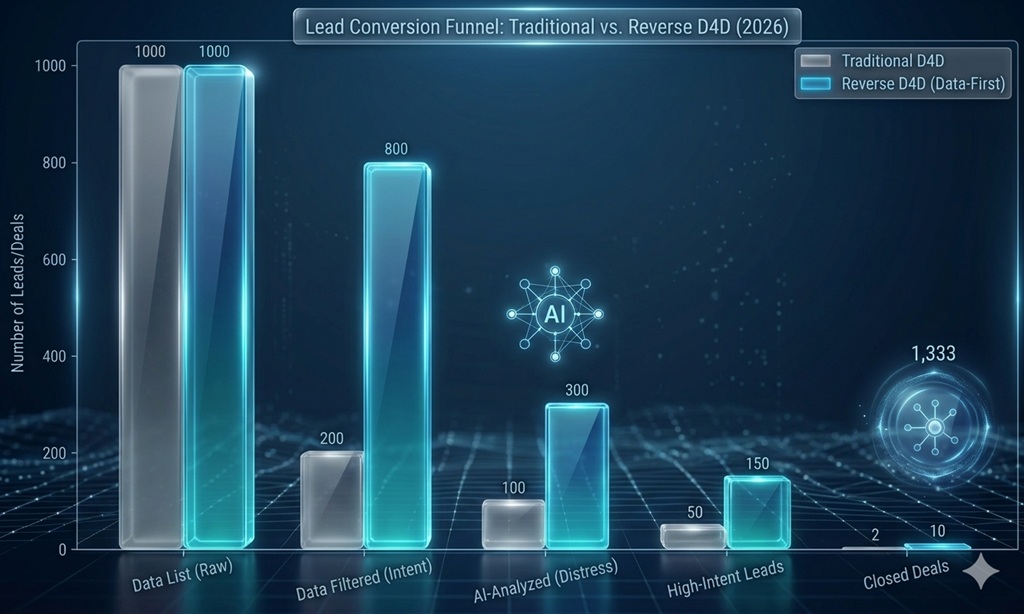
The Power of the “Data-First” Funnel
When you start with a raw list of 1,000 properties in a neighborhood, the vast majority are not for sale. In a traditional D4D scenario, you spend hours driving past well-maintained homes to find the 20-30 that show physical distress.
In the Reverse D4D model, you use data to pre-filter that list. For example, you might pull a list of 1,000 absentee owners in a specific zip code. You already know these owners are more likely to sell than a primary resident. But you still don’t know which of those 1,000 properties are actually in poor condition.
This is where the “Reverse” part of the strategy becomes incredibly powerful. Instead of driving to each of those 1,000 addresses, you use an AI-powered analyst to do the work for you.
Automating the Verification with AI
Once you have your data-driven list, you need to verify which properties are physically distressed. In the past, this meant hiring a virtual assistant (VA) to manually look at each address on Google Street View—a slow and subjective process.
Today, tools like Distress Meter AI can analyze an entire list of thousands of addresses in minutes. The AI scans the latest street-level imagery and provides:
- A Distress Score (0-10): An objective rating based on visual signs of neglect (peeling paint, overgrown yards, structural issues).
- A Concise Description: A summary of the specific issues found, such as “overgrown bushes blocking windows” or “visible roof damage.”
By combining high-intent data with AI-powered visual analysis, you transform a “cold” list into a “warm” lead list of physically distressed properties owned by motivated sellers.
| Metric | Traditional D4D | Reverse D4D (AI-Powered) |
|---|---|---|
| Starting Point | Physical Street (Random) | Digital Data List (Targeted) |
| Market Reach | Local Only | Nationwide |
| Lead Quality | High (Visual Only) | Very High (Data + Visual) |
| Time to Build List | Days or Weeks | Minutes or Hours |
| Scalability | Low (Manual Labor) | High (Software-Driven) |
| Cost per Deal | High (Gas, Time, Labor) | Low (Software Subscription) |
The “Data-to-Deal” Advantage
The primary advantage of the Reverse D4D method is the dramatic increase in your conversion rate. Because you are only contacting homeowners who are both statistically likely to sell (based on data) and have a property that physically needs help (based on AI analysis), your marketing is incredibly targeted.
Instead of sending 1,000 postcards to a general list and hoping for a 0.5% response rate, you can send 100 postcards to a hyper-targeted list and see a much higher engagement. This “sniper” approach saves you thousands of dollars in marketing costs and hundreds of hours in follow-up time.
How to Implement Reverse D4D in Your Business
Ready to flip the script? Here is the basic workflow for a Data-First wholesaling business:
- Pull Your Data: Use a tool like PropStream or BatchService to pull a list of homeowners with high-motivation indicators (e.g., absentee owners with 50%+ equity).
- Upload to Distress Meter AI: Take your list of addresses and upload it to the AI analysis platform.
- Filter for Distress: Focus only on the properties that receive a Distress Score of 6 or higher.
- Initiate Marketing: Send a targeted mailer, make a call, or send a text to the owners of these specific properties.
- Close the Deal: Since you already know the property is distressed and the owner has a reason to sell, your conversation starts from a position of strength.
Conclusion: Driving with Data, Closing with AI
In 2026, the most successful real estate investors are no longer “driving for dollars”—they are “driving with data.” By starting with high-intent lists and using Distress Meter AI to automate the visual verification, you can build a lead generation machine that is faster, cheaper, and more accurate than anything your competitors are using.
Stop looking for deals and start letting the data find them for you. The Reverse D4D method is the future of scalable, profitable real estate wholesaling.