How to Scale Your Wholesaling Business With Virtual Assistants (VAs)
In the early stages of a real estate wholesaling business, most investors are “solo-preneurs.” They handle everything from pulling lists and driving neighborhoods to skip tracing and cold calling. While this “hustle” is a necessary part of getting started, it is also the biggest obstacle to growth. You only have 24 hours in a day, and if you are spending eight of them manually analyzing properties, you aren’t spending enough time on the activities that actually generate revenue: negotiating and closing deals.
The secret to scaling from one deal a month to five or more is delegation. By hiring a real estate virtual assistant (VA) and empowering them with the right tools, you can build a lead generation machine that runs without you. This article explores how to integrate VAs into your workflow and how AI-powered analysis is changing the way VAs operate in 2026.
The Role of a Real Estate VA in 2026
A virtual assistant is no longer just someone who handles administrative tasks. In a modern wholesaling business, a high-quality VA is a key part of your lead generation and qualification pipeline. Their primary responsibilities often include:
- List Building: Pulling targeted data lists (absentee owners, tax delinquents, probate) from county records or data providers.
- Data Management: Keeping your CRM organized and ensuring that all leads are correctly tagged and updated.
- Initial Qualification: Filtering out the “noise” so that you only spend your time talking to truly motivated sellers.
- Marketing Execution: Managing your direct mail campaigns, social media posts, or initial SMS outreach.
The Productivity Bottleneck: Manual Property Analysis
For years, the standard workflow for a VA involved manually checking every address on a list using Google Street View. They would look at each property, one by one, and note signs of distress like peeling paint or overgrown yards. This is a slow, tedious, and highly subjective process.
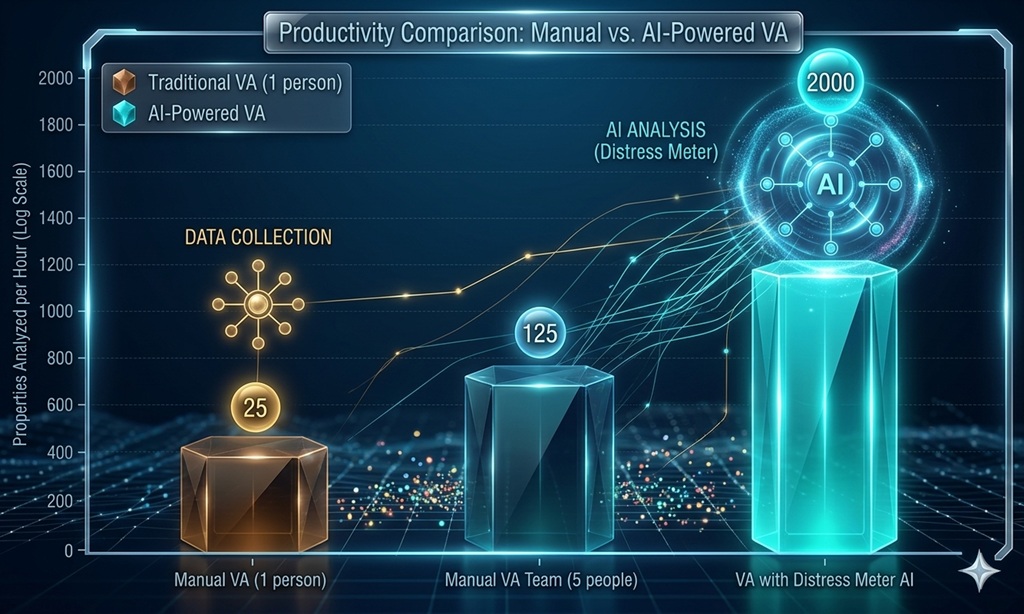
A typical VA can manually analyze between 20 and 30 properties per hour. While this is faster than you doing it yourself, it is still a significant bottleneck. If you pull a list of 2,000 potential leads, it would take a single VA over 80 hours of manual work just to identify which properties are actually distressed. This delay means that by the time you reach out to a homeowner, your competition may have already beaten you to the punch.
Breaking the Bottleneck with AI-Powered VAs
In 2026, the most successful investors are no longer asking their VAs to analyze properties—they are asking them to manage the AI that does the analysis. By using Distress Meter AI, a single VA can do the work of a team of ten.
Instead of manually checking each address, your VA simply uploads the entire list to the AI platform. Within minutes, the AI scans thousands of properties, provides an objective Distress Score (0-10) for each, and gives a concise description of the issues found.
| Method | Properties Analyzed per Hour | Role of the VA |
|---|---|---|
| Manual Analysis | 20 - 30 | Data Entry & Subjective Analysis |
| Manual VA Team (5 People) | 100 - 150 | High Management Overhead |
| VA + Distress Meter AI | 2,000+ | System Manager & Quality Review |
Building a Scalable Lead Generation Workflow
Ready to scale? Here is the blueprint for a highly efficient, AI-powered VA workflow:
- Step 1: The Data Pull. Your VA pulls a list of high-intent leads (e.g., absentee owners with 50%+ equity in a specific zip code).
- Step 2: The AI Analysis. The VA uploads the list to Distress Meter AI. While the AI works, the VA can move on to other high-value tasks.
- Step 3: Filtering for “Hot” Leads. The VA filters the results to focus only on properties with a Distress Score of 7 or higher.
- Step 4: Marketing Launch. The VA initiates your marketing sequence (direct mail, text, or call) for these high-priority leads.
- Step 5: The Hand-off. When a motivated seller responds, the VA gathers basic information and hands the lead off to you (the investor) to close the deal.
Why This Model Wins in 2026
This workflow is the key to scalability for several reasons. First, it lowers your overhead. You don’t need a large team of VAs to handle high volumes of data; you just need one competent assistant and the right software. Second, it increases your speed to market. You can analyze an entire city in a single afternoon and be the first to reach out to the owners of distressed properties.
Finally, it ensures consistency. Human VAs can have “off days” or different opinions on what constitutes a “distressed” property. The AI provides a consistent, objective score every single time, giving you a reliable data set to build your business upon.
Conclusion: Work On Your Business, Not In It
The difference between an investor who is “grinding” and an investor who is “scaling” is the systems they put in place. By hiring a VA and equipping them with Distress Meter AI, you are building a system that can handle unlimited volume with minimal effort.
Stop being the “analyzer” in your business. Hire an assistant, automate your property research, and start focusing on the one thing that truly grows your wealth: closing deals.