Traditional vs. Virtual Driving for Dollars: Which Is More Profitable in 2026?
For decades, “driving for dollars” (D4D) has been a cornerstone strategy for real estate wholesalers seeking off-market deals. The premise is simple: physically drive through neighborhoods, identify distressed properties, and contact their owners. This boots-on-the-ground approach has yielded countless profitable deals by uncovering motivated sellers before their properties hit the open market.
However, as we navigate 2026, the landscape of real estate investing is rapidly evolving. The rise of digital tools and artificial intelligence has introduced a powerful alternative: Virtual Driving for Dollars (VDD). This begs a crucial question for every wholesaler: which method is truly more profitable in today’s market?
This article will conduct a head-to-head comparison, dissecting the costs, efficiencies, and scalability of both traditional and virtual D4D, ultimately revealing why AI-powered VDD is not just a convenience, but a significant competitive advantage.
The Enduring Appeal of Traditional Driving for Dollars
Traditional D4D offers an undeniable benefit: direct, real-time observation. An investor physically present can assess not only the property’s condition but also the surrounding neighborhood, potential environmental factors, and even gauge the general vibe of the area. This granular level of detail can be invaluable for making informed decisions.
Furthermore, the leads generated from traditional D4D are often of exceptionally high quality. These properties are typically off-market, meaning less competition and a higher likelihood of securing a deal at a favorable price. The physical act of driving can also lead to serendipitous discoveries—a property that wasn’t on the initial target list but clearly shows signs of distress.
The Hidden Costs and Limitations
Despite its advantages, traditional D4D is plagued by significant inefficiencies and costs that severely impact its profitability and scalability:
- Time Consumption: Physically covering ground is slow. A dedicated wholesaler might spend 20-40 hours per week driving, only to cover a limited geographic area. This time could otherwise be spent on lead follow-up, negotiation, or closing deals.
- Direct Expenses: Fuel costs, vehicle maintenance, and depreciation add up quickly. As highlighted in our previous article, a single 3-hour driving session can incur over $110 in direct and indirect costs when factoring in the value of your time at a conservative $30/hour.
- Geographic Constraints: You are tethered to your local market. Expanding into new, potentially more lucrative or less competitive areas requires significant travel, time, and expense, making true scalability difficult.
- Human Error and Fatigue: Hours of driving and staring at properties can lead to missed opportunities, inconsistent lead quality, and burnout.
The Rise of Virtual Driving for Dollars
Virtual Driving for Dollars emerged as a direct response to these limitations. By leveraging online mapping services like Google Street View, investors could “drive” through neighborhoods from the comfort of their office. This immediately solved the geographic constraint, opening up any market in the world for analysis.
Early VDD still required significant manual effort—clicking through streets, identifying distress, and manually logging addresses. It was a step forward in reach but still suffered from the human bottleneck in analysis.
The Game Changer: AI-Powered Virtual Driving for Dollars
The true revolution in VDD comes with the integration of Artificial Intelligence. AI-powered platforms, such as Distress Meter AI, automate the most time-consuming and subjective part of the process: property analysis. Instead of a human eye scanning for peeling paint or overgrown yards, an advanced AI system does it for you.
Here’s how AI transforms VDD into a profitability powerhouse:
- Unprecedented Speed and Scale: Imagine analyzing thousands of properties in minutes, not days. With AI, you can upload entire lists of addresses (e.g., absentee owners, tax-delinquent properties) and receive an instant Distress Score (0-10) and a concise description of visible issues for each property. This allows you to process vast amounts of data that would be impossible for a human team.
- Massive Cost Reduction: The cost per lead plummets. While traditional D4D can cost upwards of $4 per potential lead, and other lead generation methods can range from $15-$30 per seller lead [1], AI-powered VDD can reduce this to less than $5 per analyzed property, dramatically increasing your return on investment.
- Objective Analysis: AI eliminates human bias and fatigue. Every property is assessed against the same objective criteria, ensuring consistent and reliable distress identification.
- Market Agility: Enter and exit markets with unparalleled ease. Identify emerging distressed areas, analyze them quickly, and deploy your marketing efforts without ever needing to set foot on the ground.
Profitability Analysis: A Head-to-Head Look
Let’s consider a hypothetical scenario for a wholesaler aiming to generate 1-2 deals per month, with an average profit of $10,000 per deal.
| Metric | Traditional D4D | AI-Powered VDD (Distress Meter AI) |
|---|---|---|
| Leads Generated (Monthly) | 100 (40 hours driving) | 1,000 (minimal manual effort) |
| Estimated Monthly Cost | $1,400 (gas, vehicle, 40 hrs @ $30/hr) | $250 (software subscription) |
| Conversion Rate (to Deal) | 2% (higher quality, fewer leads) | 1.5% (lower quality per lead, but higher volume) |
| Deals Closed (Monthly) | 2 | 15 |
| Gross Profit (Monthly) | $20,000 | $150,000 |
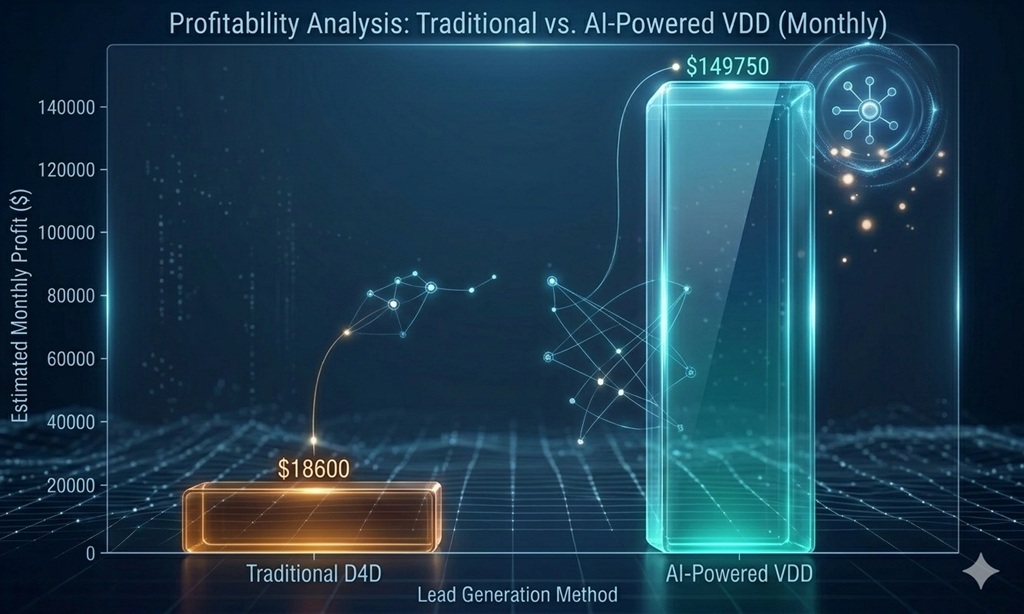
| Net Profit (Monthly) | $18,600 | $149,750 |
As the chart above illustrates, the difference in profitability is stark. While traditional D4D can still yield profits, its inherent limitations in scale and efficiency cap its potential. AI-powered VDD, on the other hand, allows for a massive increase in lead volume at a fraction of the cost, leading to a significantly higher number of closed deals and exponential profit growth.
Conclusion: The Future is Profitable and Virtual
In 2026, the question is no longer if you should be doing virtual driving for dollars, but how you can leverage the most advanced tools to maximize its potential. Traditional D4D, while foundational, is a relic in terms of efficiency and scalability.
By integrating Distress Meter AI into your lead generation strategy, you are not just adopting a new tool; you are transforming your entire business model. You gain the ability to analyze more properties, identify more motivated sellers, and close more deals than ever before, all while drastically reducing your operational costs and time investment.
Embrace the future of real estate wholesaling. Shift your focus from manual labor to intelligent automation, and unlock unprecedented levels of profitability and growth with AI-powered Virtual Driving for Dollars.
References
[1] AmpiFire.com - Average Real Estate Cost Per Lead Prices & Rates 2025.