Virtual Driving for Dollars: The 2026 Guide to Finding Off-Market Deals From Your Desk
The hunt for the next great real estate deal is relentless. For decades, the most ambitious investors have sworn by a single, time-tested strategy: driving for dollars. The concept is simple — drive through target neighborhoods, look for properties showing signs of neglect, and contact the owners. These distressed properties often signal a motivated seller, opening the door to lucrative off-market deals.
But in 2026, the idea of spending hours burning gas, stuck in traffic, and manually jotting down addresses feels outdated. The physical grind is inefficient, expensive, and geographically limiting.
What if you could find those same golden opportunities in any market across the country, without ever leaving your chair?
Welcome to the world of virtual driving for dollars (VDD). This modern approach leverages technology to achieve the same goal with unparalleled efficiency and scale. And now, with the advent of AI analysis, the game is changing once again. This guide will walk you through everything you need to know to master VDD and build a scalable, cost-effective deal-finding machine.
What is Virtual Driving for Dollars?
Virtual driving for dollars is the process of using online mapping tools, primarily Google Maps Street View, to digitally “drive” through neighborhoods and identify properties that exhibit signs of distress. Instead of physically being there, you navigate streets on your computer, looking for the same tell-tale signs:
- Overgrown lawns and untamed landscaping
- Peeling or faded paint
- Boarded-up windows or doors
- Damaged roofs, gutters, or siding
- Visible structural issues like cracks in the foundation
- Piled-up mail or old newspapers
By spotting these properties from your desk, you can build a highly targeted list of potential off-market deals to pursue.
The End of an Era: Why Traditional Driving for Dollars is Broken
While traditional driving for dollars can work, its limitations have become glaringly obvious in the digital age.
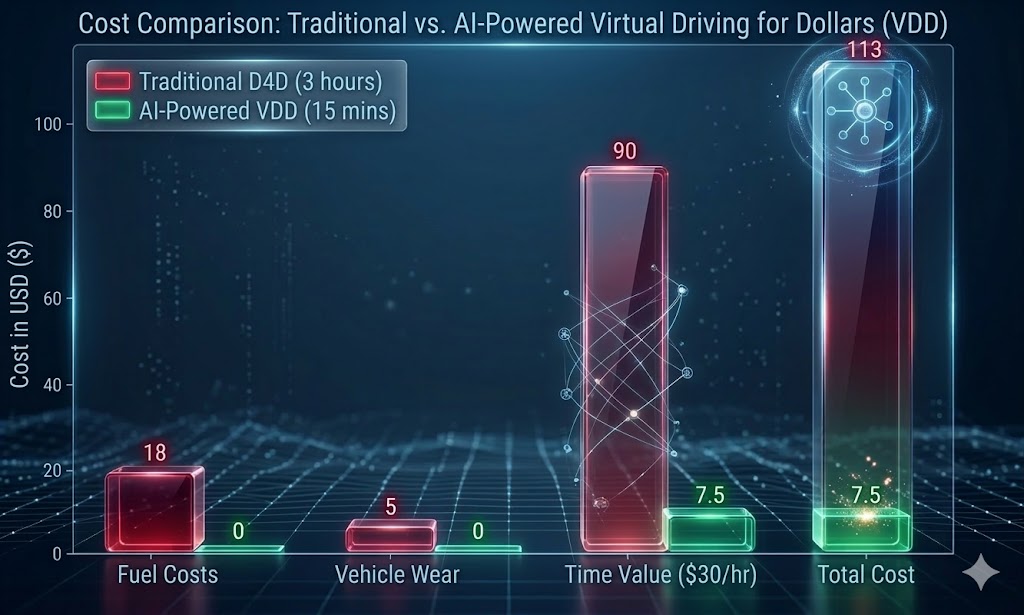
Let’s break down the real cost of a “drive.” A typical 3-hour session might look like this:
- Fuel Costs: $15–$20 (depending on your vehicle and gas prices)
- Vehicle Wear & Tear: ~$5 (depreciation, tires, maintenance)
- Your Time: If you value your time at a conservative $30/hour, that’s $90.
Total Cost for one 3-hour drive: Over $110.
In that time, you might identify 20–30 potential properties. That’s a cost of roughly $4 per potential lead.
Beyond the direct costs, the problems are even bigger:
- It’s Not Scalable: You can only cover so much ground in a day.
- It’s Geographically Locked: You’re limited to markets within driving distance. Want to invest in a more affordable market three states away? You’re out of luck.
- It’s Inefficient: You spend more time driving through pristine, well-kept neighborhoods than you do spotting actual opportunities.
Virtual driving for dollars was created to solve these problems.
How to Drive for Dollars Virtually: The Step-by-Step Method
Ready to build your first list? Here’s how the standard VDD process works.
Step 1: Choose Your Target Market and Neighborhood. The beauty of VDD is that you can choose any market. Start by identifying a zip code or neighborhood that aligns with your investment criteria (e.g., median home price, age of housing stock).
Step 2: Open Google Maps and Enter “Street View.” Drop the “Pegman” (the little yellow person icon) onto a street in your target area. This will immerse you in the 360-degree street-level view.
Step 3: “Drive” the Streets and Hunt for Distress. This is the core of the task. Click your way down the street, block by block. Pan around, zoom in, and inspect every property. Keep your eyes peeled for the signs of neglect mentioned earlier.
Step 4: Document Your Leads. When you find a potential property, you need to capture the information. Create a simple spreadsheet with columns for:
- Full Address
- Date Spotted
- Notes on Distress (e.g., “overgrown yard, peeling paint on garage”)
- A screenshot of the property
Step 5: Find the Owner and Make Contact. Once you have a list of addresses, use a skip-tracing service to find the owner’s name and contact information. From there, you can initiate your marketing, whether it’s through direct mail, a phone call, or another method.
This process is a massive improvement over physical driving. But as you can see in Steps 3 and 4, it still involves a significant amount of manual, tedious work. Clicking through endless streets and analyzing thousands of images is a time-consuming bottleneck.
The Next Evolution: From Manual VDD to AI-Powered Analysis
The manual VDD process solves the “location” problem, but it doesn’t solve the “analysis” problem. You still have to spend hours acting as a human image-recognition machine.
This is where AI changes everything.
New services are emerging that automate the most painful part of the process: the analysis. Instead of you manually looking at each house, an AI can do it for you.
This is the core innovation behind Distress Meter AI. Our service was built to eliminate this final bottleneck. You simply provide an address, and our AI analyzes the latest Google Street View image to instantly provide:
- A Distress Score (0–10): A simple, objective rating of the property’s condition. A score of 8 might indicate a severely overgrown yard and a damaged driveway, while a 2 represents a well-maintained home.
- A Concise Description: The AI provides a short summary of why it assigned the score, such as “peeling paint on siding, overgrown bushes, visible cracks on walkway.”
By leveraging AI, you transform the VDD workflow. The process is no longer about manually looking for needles in a haystack. It’s about feeding the haystack to a machine and getting a neat list of needles in return.
The AI-Powered Workflow: Efficiency Multiplied
With a tool like Distress Meter AI, your deal-finding process becomes 10x more efficient.
- Acquire Address Lists: Instead of randomly driving streets, you can start with data. Obtain lists of addresses based on specific criteria (e.g., absentee owners, high-equity properties, pre-foreclosures).
- Batch Analyze with AI: Upload your list of hundreds or thousands of addresses to the Distress Meter AI system.
- Receive Your Prioritized Leads: Within minutes, you get your list back, now enriched with a Distress Score for each property. You can instantly sort by this score to focus only on the most promising leads (e.g., any property with a score of 6 or higher).
Think about the time savings. Manually reviewing 1,000 properties could take a full-time employee two days. With AI, you can get it done in less than 15 minutes. You’re no longer paying for manual labor; you’re investing in instant, accurate analysis. This allows you to focus your time and money on what truly matters: talking to motivated sellers and closing deals.
Virtual driving for dollars is no longer just a concept; it’s a powerful, evolving strategy. By embracing AI, you can move beyond the competition, scale your operations into any market, and build a truly modern real estate investment business.